
TV Wall Mounting in Santa Ana
TV Mounting Frame Santa Ana covers everyday TV wall mounting across Santa Ana — living rooms, dens and bedrooms in a city where a single block can hold a 1920s bungalow, a 1950s ranch house and a new infill townhome — where a local installer finds the framing behind each wall, hangs a fixed or tilting bracket and leaves the cords tidy.
Bookings aren't open yet. Leave your name and number; your message is recorded, and you'll get one message when a local installer is available.
 Illustration
Marking the studs and hanging the plate
Every wall in the city is different, so the sequence stays the same.
- Read the TV. Its weight and the four threaded holes on the back are noted, and the bracket must be rated at least 1.5 times the weight.
- Find the wood. A stud finder marks the framing, and one small probe hole under the future plate proves where a stud edge sits.
- Tape the screen. Painter's tape shows the outline on the wall; a minute on the sofa settles whether the height looks right.
- Drive the bolts. Pilot holes, lag bolts into the center of the studs and a level, snugged until the plate lies flat.
- Hang and lock. The TV hooks on, the lock screws go in and the level is read again with the weight on.
- Dress the cords. Cables are tied to the outlet and the household is shown how the tilt works.
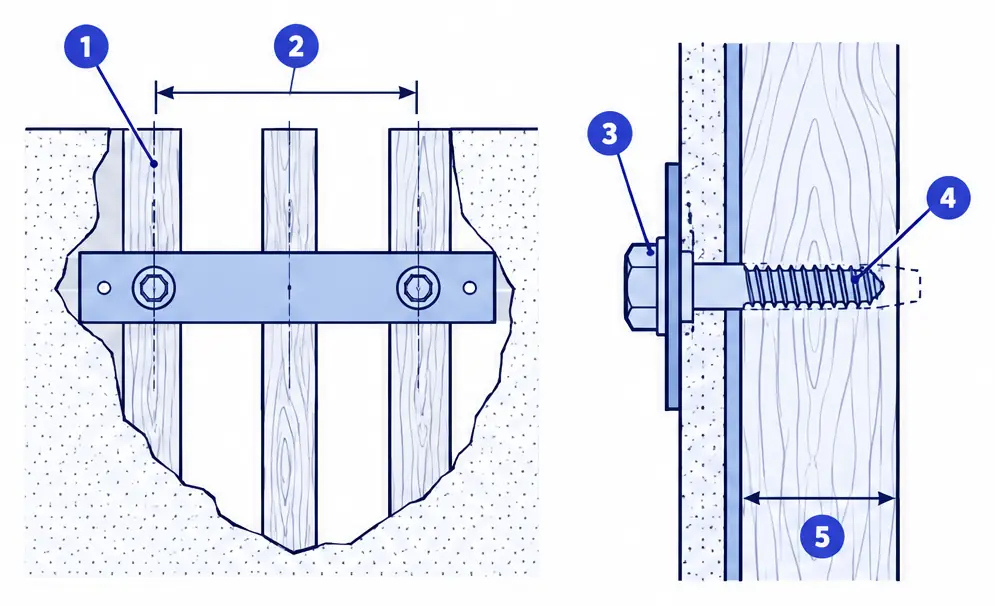
What the numbers show
- Stud center line The bolt is aimed at the middle of the stud, found with a finder and a probe hole.
- Span across the studs Studs usually sit about 16 inches apart on center; this plate spans from one stud to the second one over and is bolted at both.
- Washer and head A washer under the head spreads the clamp load over the plate.
- Threads in solid wood The threads bite into the stud, not into the drywall.
- Depth into the stud The bolt ends inside the stud and does not break through the far side.
When the studs miss the screen
Studs in wood-framed Santa Ana houses sit about 16 inches apart, but additions, remodeled kitchens and old doorways break the pattern. A wide plate reaches two studs while the picture stays centered, and a plate with sliding brackets moves the set a few inches without moving the holes.
- Strap toggles open behind drywall like a bar and spread the load along a strip.
- A backer board screwed across several studs gives a large screen a solid face.
- Split fixing puts one side of the plate on lag bolts and the other on toggles.
Heavy sets and wide plates
A 75-inch or larger set can weigh well over 80 pounds, and the plate that holds it is wide. The installer weighs the box before the visit if the owner knows the model, checks that two studs sit under the plate's slots, and plans two people for the lift. A big TV is never hung alone from a ladder.
Matching the finish to the room
Santa Ana rooms range from bright white drywall to painted woodwork that has been in the family for decades. The installer covers the floor, tapes the drill spot and brings a small vacuum so fine dust does not settle on the trim. A bracket in a dark finish disappears behind a dark TV; a white wall takes a black plate without a fuss.
TV Wall Mounting — common questions
How much does a basic TV wall mount cost in Santa Ana?
Expect roughly $95–$135 for a 32–49 inch set and $115–$169 for 50–65 inches on drywall over wood studs in 2026. Larger TVs and harder walls move the figure up.
Who supplies the bracket?
Either side can. If the installer supplies one, the add is $40–$120 by type and size; a bracket already owned is first checked against the set's weight.
Availability & price range
TV Wall Mounting: check availability and price range
Bookings aren't open yet — answer a few quick questions about the TV and the wall and get a typical Santa Ana price range right here. Typical Santa Ana prices for one TV, labor only unless an option says otherwise. This is a market estimate, not a quote.